By Donna King
Raleigh, NC – orth Carolinians are not immune to what has become near hysteria over the growth of data centers and their role in the modern economy. Just one year ago, a Heatmap Pro/Embold Research poll found that 42% of Americans opposed a data center near their homes. Today, 75% oppose one. What changed so dramatically in just a year?
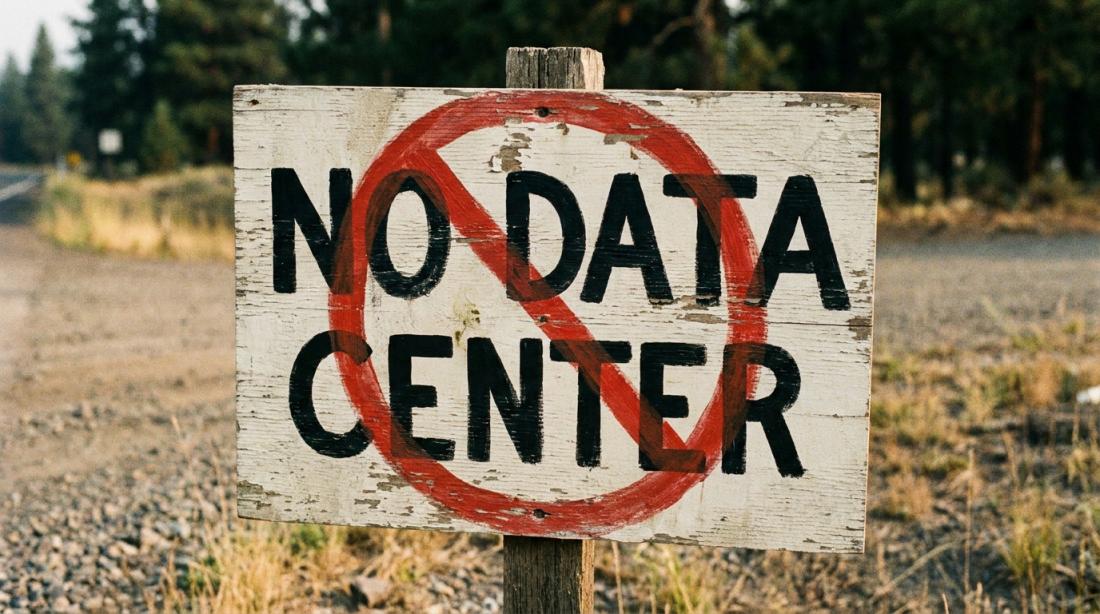
Some conservatives think data centers represent “woke” ideology, while liberals associate them with Big Tech and corporate fat cats. Others cite alarming claims about water use, while still others simply think the facilities are ugly or noisy. Overall, opposition appears to be emerging as a proxy for society’s broader discomfort with the power and promise of artificial intelligence. Ironically, many of these arguments are made online through social media posts, protest campaigns, and memes — all supported by the same computing infrastructure critics oppose.
I’m generally not a conspiracy theorist, but OpenAI recently identified a likely China-origin group that posed as Americans and generated online content criticizing US data centers. That does not prove China is behind the broader backlash, but few countries would benefit more from America slowing the development of its AI infrastructure. Foreign actors may not have created the controversy, but they have demonstrated a willingness to exploit it.
The backlash is going strong in North Carolina despite widespread misunderstanding of the issue. More than 30 North Carolina local governments reportedly imposed temporary moratoriums between February and July 2026. They include Charlotte, which approved a 150-day pause. If North Carolina turns projects away indiscriminately, the investment will go elsewhere.
Electricity demand from data centers could double or triple by 2028, according to the US Department of Energy. Before we reject the computing capacity needed for a future of diseases cured, wars fought, classes taught, and fortunes made, North Carolinians should evaluate data centers based on facts and their actual local effects.
The major questions are straightforward: How much electricity and water will a proposed facility use, and does the community have the infrastructure to support it? Will the data center owner buy, bring, or build the power generation it needs without shifting the cost onto neighboring households and businesses?
Water use is often cited by critics who warn that submitting a ChatGPT prompt is akin to flushing a toilet. The reality is more complicated and far less sensational. The original study making that claim has been widely questioned or misquoted. The real usage is far less, and data center permits may seek authorization for the maximum amount of water a facility could require, even if its actual consumption is much lower. Actual water use can be metered, documented, and evaluated against the capacity of the local water supply.
According to New Orleans AI expert Knud Berthelsen, a Tulane University professor of practice and senior adviser for AI Literacy, data centers are actually incredibly efficient machines.
“The computing has to happen somewhere,” he said. “The data center is an incredibly efficient way of doing it. Your own computer and phone are incredibly inefficient.”
“I also disagree with the whole concept of the water usage,” he added.”It comes in in one state, it goes out in a different state, and it has not been polluted. It’s just part of the the cycle of of of water.”
Facilities also use different cooling technologies. Some rely on evaporative cooling, while others use closed-loop systems, reclaimed water, or air cooling. Google, for example, uses air cooling at its Mesa, Arizona, facility because of concerns about local water scarcity. Noise and visibility should be addressed through objective local standards governing setbacks, sound levels, and landscaping, just as communities regulate other industrial and commercial developments.
Regardless of the revenue a data center could bring to a community, it should compete for land, labor, power, and capital like other businesses. If a project makes economic sense only after taxpayers subsidize it, it will not survive free-market scrutiny. North Carolina should also welcome the infrastructure of the future under fair and predictable rules without special incentives, but also without special penalties. Critical thinking, not online hysteria, should guide that decision.
Donna King serves as editor-in-chief for the Carolina Journal and Executive Vice President of the John Locke Foundation